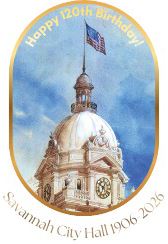
On this day, 120 years ago, City leaders threw open the doors of our brand-new, modern City Hall for inspection by our citizens. As we enter our 120th birthday year, City Hall is undergoing a transformative interior restoration (now in Phase 3 focusing on the grand four-story rotunda and wrap-around marble staircase) to preserve and protect this important public asset for the next century of use. Throughout this birthday year, we will be reflecting on City Hall’s architectural significance, sharing historical moments that have transpired under the dome over the past 120 years, and celebrating milestones in the restoration project. To kick it all off, today we look back 120 years ago on January 2, 1906, at City Hall’s grand opening.
10,000 Citizens Visit City Hall for Opening Reception (taken from “The Birth of City Hall, 1903-1906”)
On January 2, 1906, City Hall was thrown open to the citizens of Savannah, the rightful owners of the building, for inspection. Two receptions were held, one in the afternoon from 3:30 until 5 o’clock, to give ladies and children an opportunity to view the building, and one in the evening from 8 o’clock until 10:30.
Literally thousands of persons—men, women and children—thronged the building during the hours it was open for inspection, and the unanimous opinion was of admiration and praise. That the people feel genuine pride in the city government’s new home was very evident from the comments that were to be heard on all sides as the throngs came and went.
In early November 1905, as the building neared completion, the City Hall Building Committee decided to skip an elaborate affair for the grand opening of the building, like that of the cornerstone laying ceremony, and simply have a public reception with no public speaking of any kind. On December 18, 1905, City Council chose Tuesday, January 2, 1906 as the date for the reception. The Building Committee handled most of the details, meeting on December 26th in the Mayor’s office to finalize the plans. Chairman of Council James M. Dixon was responsible for arranging music for the reception and Mayor Myers requested all department heads and their clerks to be on duty during the reception to answer questions and show guests around the new offices.
In each office there will be somebody to show the visitors around and explain what the different conveniences and ornaments are and how the work for the city is done. Everybody in the building has about settled down to the routine work interrupted by the moving, and the visitors Tuesday will be in a position to judge just how everything looks when the machinery of the municipal government is moving in the city hall. The building and everything in it will belong to the visitors and they will be expected to ask questions if there is anything they do not understand….
Everyone was requested to appear in formal attire, if possible, for the evening reception. Formal invitations were not sent out, the Mayor merely made an announcement and the local newspapers publicized the event.
Custodian R. W. Ferguson had his hands full keeping the building clean between the time the departments moved in and the reception, a steady stream of visitors tracking in dirt. The day before the reception was New Year’s Day and the building was closed for the holiday, giving Ferguson a good opportunity to clean up the building. Palms, potted plants, and flowers of various kinds, borrowed from the Park and Tree Commission, were placed in the rotunda and corridors to make the building “a bower of green.”
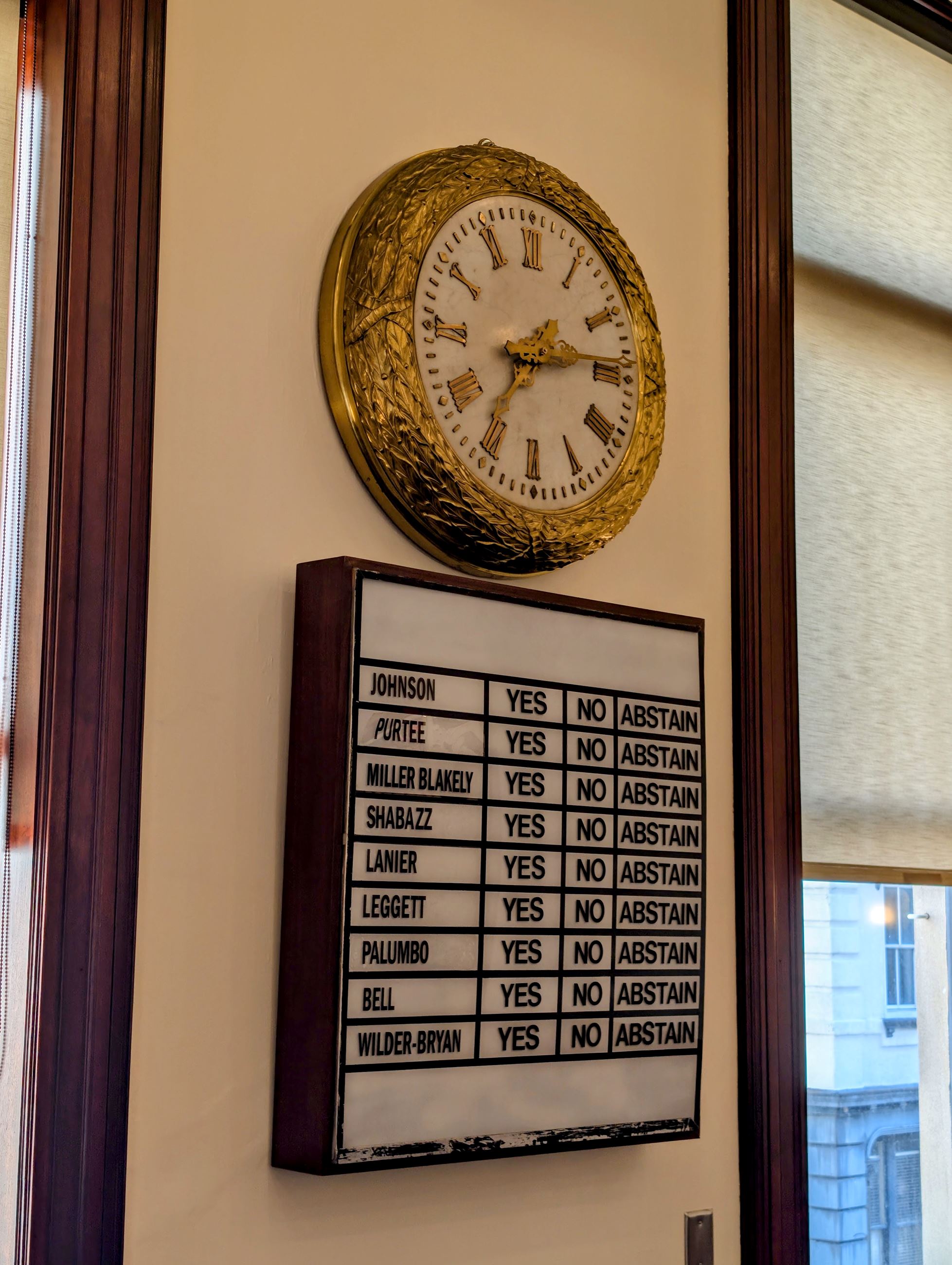
Bronze and marble Council Chamber clock restored and rehung in the Council Chamber.
Photograph by Ethos Preservation, August 2025.
In anticipation of the event, workers rushed to finish several small details in the building. The new portrait of Mayor Myers and the bronze wall clock were hung in the Council Chamber. Two marble tablets were installed in the first floor rotunda, one containing a directory of the City departments and the location of their offices by floor, the other listing pertinent information to the construction of the City Hall, including the names of the Mayor and Aldermen during the building’s construction, the Building Committee, the architect, the building contractor, and the date of completion. The fountain basin, devoid of the bronze fountain not yet finished, was filled with water and goldfish Custodian Ferguson had secured from the Park and Tree Commission.
The afternoon reception was attended by approximately 4,000 people, a large majority of them women and children.
A feature of the afternoon reception was the Mayor’s conversation with the many little children, who thronged his office. One of the first youngsters to enter confided to his honor that when he grew up to be a man he was going to be Mayor and have his office in the City Hall. He liked it. After that Mayor Myers told each of the boys that he could be Mayor when he grew up. He told the little girls much nicer things.*
Mayor Herman Myers secured souvenirs for visitors to take away at a cost of $400. Thomas Halligan and Roy Bailey distributed them in the Mayor’s reception room as visitors passed by in a line. Some guests were disappointed they could not have more than one, while some accused others of getting in line more than once to receive a second souvenir.
They are little trays with a reproduction of the City Hall on them, making exceptionally pretty ornaments. They may be used as either pin or ash trays and are suitable souvenirs for both women and men.
Wiegand’s Orchestra, led by Director John Wiegand, Jr., provided music from the second-floor rotunda during both receptions. During the afternoon affair, the play list included “National Airs,” “Tannhauser” (Wagner), “Golden Sunset” (Hall), “Courtesy” (Wiegand), “Carmen” (Bizet), “Love’s Sorrow” (Shelley), and “Call of the Wild” (Losey).
The visitors went at will through the building inspecting it from tower to basement. In each office they were received by one of the heads of departments, or their assistants, and made to feel at home. On the second floor, where the office of the Mayor, the Council Chamber and the clerk of Council are located, it was necessary to form lines to prevent a congestion in the crowd. The police on duty saw to this, and the crowds, even when they were largest, managed to get through and see everything with little confusion.
The afternoon reception was marred by one incident. Harold McDonald, a teenager of 16 or 17 years of age, fainted while in the City Hall tower. After recovering, he still wanted to go out on the roof, but those afraid for his health convinced him otherwise. “McDonald is unfortunately afflicted. His illness created some excitement in the City Hall.”
The evening reception was also well attended, with an estimated 6,000 visitors, mostly men and women, touring the City Hall. “Expressions of surprise at the beauty of the structure were heard on every side.”
The reception really developed into surprise parties for the citizens, for no one who had not previously visited the building had any conception of the beauty and artistic arrangement of the interior. Mayor Myers, who received the visitors in his private office, and all the city officials were warmly and repeatedly congratulated upon the appearance of the building. Architect Witcover, who was present at the receptions, was kept almost as busy as the Mayor, shaking hands and responding to congratulations.
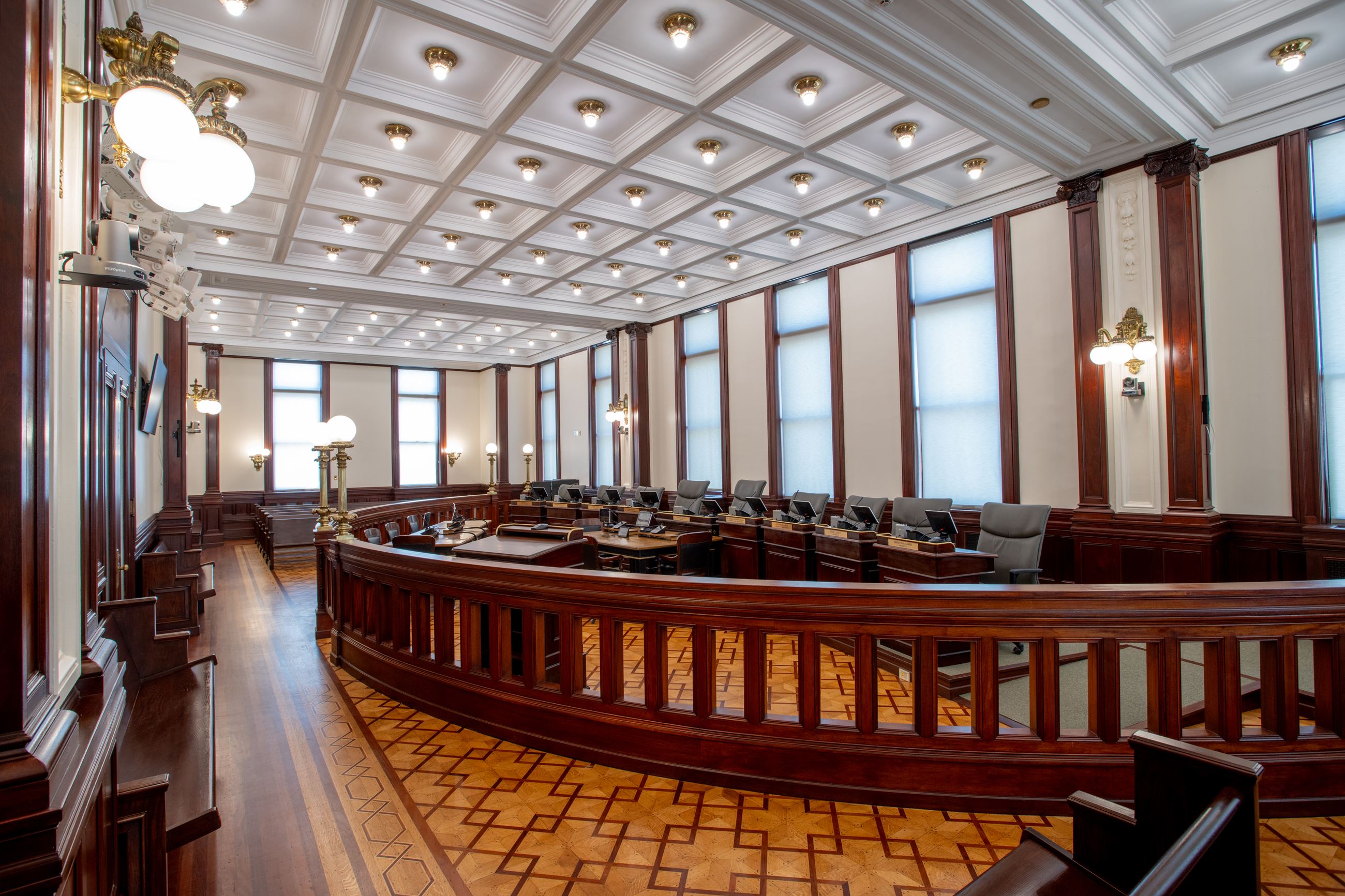
Restored Council Chamber featuring original electric lighting fixtures and metal aldermen desks.
Photograph by Jason Thrasher, August 2025.
The appearance of the building at night, lit by the electric fixtures, presented a dramatic appearance. The fountain basin was lit with colored, miniature bulbs which created a beautiful effect on the palms. The Council Chamber ceiling was brilliantly illuminated by the electric lights in the coffered ceiling panels. “The Council Chamber is by far the handsomest part of the building and it was there that the visitors lingered longest…. Numerous electric lights in the ceiling add to the beauty of the room and make it a chamber of brilliance when they are turned on.” Features that appealed particularly to visitors included the metal furniture, which was still fairly uncommon at this time, and the Mayor’s oil portrait.
The portrait of Mayor Myers, only recently finished by Mr. Ambrose MacNeil, the Scotch artist, attracted a good deal of attention in the Council Chamber. The Mayor was somewhat embarrassed by having several ladies tell him that it did not do him justice, that he was much handsomer than the picture showed him to be.
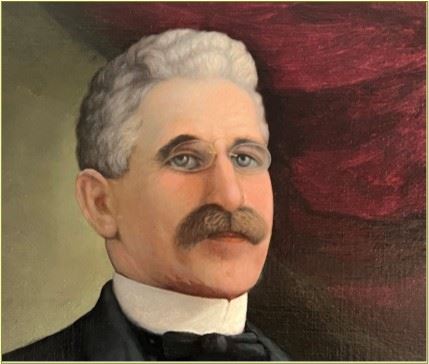
Mayor Herman Myers’ portrait, painted by Ambrose DeBarra MacNeil in 1905.
Photographed in 2025 after conservation.
The orchestra’s evening concert included “Patriotic Airs of Two Continents” (Rollinson), excerpts from “Babes in Toyland” (Herbert), a cornet solo of “O Dry Those Tears” (Reigo), the waltz “On the Beautiful Danube” (Strauss), “What the Brass Band Played” (Morse), selections from “Faust” (Gounod), “Moonlight” (Meret), “Light Calvary” (Suppe), Wiegand’s march entitled “De Soto,” and in closing the “Star Spangled Banner.”
All the colored porters were on duty in the respective offices in which they are employed, but Willis, in the clerk of Council’s office, made the hit of the evening among this contingent of the city’s employees. His immaculate white jacket gave promise of refreshments that did not materialize. A brilliant carnation spoke eloquently and aggressively of the joyousness of the occasion, while his white knit gloves seemed to deny the spirit of the remainder of his attire, suggesting a funeral or some other solemn event. Willis was certainly one of the hits, and there were many.
[To learn more about City Hall’s porters watch the Hungry for History program History Bites: "Henry Willis and City Hall's Porters"]
All visitors seemed extremely pleased with the building, “modern in the fullest sense.” One visitor stated, “I like every office I enter better than the one I have just left, no matter which way I go.” Another nicknamed City Hall “the Coconut Building,” as being better on the inside than on the outside. Unfortunately, Chairman of Council Dixon was unable to attend the receptions due to illness. Mayor Myers was exhausted at the end of the evening from shaking hands the entire time, but everyone agreed the building and the reception were successes.
During the first full month the City Hall was open, visitors continued to stop by. On January 31, 1906, Charles Edgeworth Jones, of Augusta, paid a visit. His father was Charles C. Jones, Mayor of Savannah at the outbreak of the Civil War. “The visitor inspected the Council Chamber and gazed upon the picture of his father, which occupies a place with all the Mayors of the city.” The following day, Mr. L. S. Richardson, of the Municipal Journal, of New York, included City Hall in his tour of Savannah.
Mr. Richardson was very much impressed with the City Hall. He says he has, of course, seen many costlier structures, but he has never seen a city building better adapted to the uses for which it is intended. He says it compares favorably with the Richmond City Hall, which cost over a million dollars…. Very few City Halls are ever what they should be, he says, as neither city officials or architects usually understand what is needed.
*Savannah’s first female mayor was Susan S. Weiner, who was inaugurated on January 2, 1992 and served through December 31, 1995.
Sources:
“Have Souvenirs for City Hall Opening.” Savannah Morning News (19 December 1905) 10:2.
“Mayor Had 10,000 Callers.” Savannah Morning News (3 January 1906) 12:1.
“Mayor Myers’ Picture in Council Chamber Now.” Savannah Morning News (2 January 1906) 12:1.
“The New City Hall.” Savannah Morning News (3 January 1906) 5:3.
“On Tuesday Citizens Invited to Inspect Handsome City Hall.” Savannah Evening Press (30 December 1905) 11:1-7.
“Only Reception to Mark Opening.” Savannah Morning News (2 November 1905) 12:1.
“Plans are Made for Reception.” Savannah Morning News (27 December 1905) 12:1.
“Plans Complete for Reception.” Savannah Morning News (31 December 1905) 14:1.
“Reception To-Day at the City Hall.” Savannah Morning News (2 January 1906) 12:1.
Report of Hon. Herman Myers, Mayor…for the Year Ending December 31st, 1905…and Sketch of the Old City Exchange and the New City Hall. Savannah: Braid & Hutton, 1906.
“Son of Former Mayor Visited City Hall.” Savannah Morning News (1 February 1906) 12:4.
“To Occupy City Hall in December.” Savannah Morning News (8 August 1905) 10:5.
“To Write up City in Municipal Journal.” Savannah Morning News (2 February 1906) 10:3.
“Will Fix Budget in Old Quarters.” Savannah Morning News (24 November 1905) 12:5.
To learn more about the planning and construction of Savannah’s City Hall see the City Hall Centennial history documents: