Inside the Archives

Join the City of Savannah Municipal Archives' staff as we share treasures from the archival collections and interesting tidbits of local Savannah history.

Feb 26

Unexpected Partners in the Pursuit of Liberty

Posted on February 26, 2026 at 5:34 PM by Luciana Spracher

America250_color_flat


In 1779, as the American Revolution intensified, an extraordinary regiment sailed from the Caribbean to fight in Georgia. Known as the Chasseurs Volontaires de Saint-Domingue, they were free men of color from the French colony of Saint-Domingue (present-day Haiti). These light infantry soldiers constituted the largest unit of men of African descent to fight in the American Revolution.  


Their service at the Siege of Savannah forged lasting historical ties between Haiti and the City of Savannah. 


French officers praised their discipline, resilience, and marksmanship, noting their ability to endure harsh conditions and quickly master European military drill. Despite these qualities, commanders relegated them to trench work rather than frontline combat. 


After the Continental Congress ratified an alliance with France, French and American forces launched a joint effort in 1779 to retake Savannah from the British. Approximately 545 Chasseurs joined Admiral Charles Henri d’Estaing’s expedition, along with roughly 3,000 additional troops.  


1779 HaitianTroops Battle Scene

Painting depicting the Chasseurs Volontaires in Siege of Savannah

Presented to the City of Savannah by the Republic of Haiti on October 9, 1976 


After some initial skirmishes against the British in Savannah in late September, d’Estaing ordered the ill-fated assault that would end the Siege of Savannah on October 9th at the Spring Hill redoubt. Though historical accounts differ on the precise role of the Chasseurs during the attack, it is certain that they fought bravely in support of the American cause. The assault failed, and the Franco-American army retreated. The Siege of Savannah became one of the bloodiest engagements of the war, with an estimated 244 Franco-American casualties, including at least 25 documented deaths of members the Chasseurs Volontaires. 


Many historians believe that some men who fought in Georgia later participated in the Haitian Revolution, including Henri Christophe, who would become the first King of Haiti. Their experience in Savannah contributed to evolving ideas about liberty, citizenship, and rights, which would culminate in Haiti’s independence in 1804. 


For more than a century, the Chasseurs’ contributions went largely unrecognized in the United States amid segregation and racial prejudice. In 1976, during Savannah’s Bicentennial celebration, the city strengthened its connection with Haiti by inviting Haitian diplomats to Siege of Savannah commemorations. 

Haitian Tablet

Commemorative tablet created by artist Normil Charles presented to the City of Savannah by St. Marc, Haiti, 2003.

On display in the Savannah City Hall Council Chamber.


Over time, Savannah and Saint-Marc, Haiti, developed an informal sister-city relationship marked by exchanges and mutual support. In 2003, during a Haitian delegation’s visit, the mayor of Saint-Marc presented Savannah’s mayor with a commemorative tablet created by artist Normil Charles. 

HaitianMonument

Haitian Monument, Franklin Square, 2009.  

Public Information Office Photographs (unprocessed addenda), City of Savannah Municipal Archives.


Savannah’s Haitian Monument, located in Franklin Square, was unveiled in 2007 and completed in 2009. Planned and funded by the Haitian American Historical Society, it features six life-sized bronze Chasseurs atop a granite pillar inscribed with their history. Five figures represent the unnamed Black soldiers who served with the Chasseurs and a drummer boy symbolizes Henri Christophe, believed to have fought in the Siege of Savannah. 

HaitiaanEarthquakeRelief012010 (2)

Haitian relief supply drive press conference, 2010.  

Public Information Office Photographs (unprocessed addenda), City of Savannah Municipal Archives.


Savannah has continued to support Haiti in times of need, including sending heavy machinery to Saint-Marc in 2008 and organizing relief supplies after Haiti’s devastating 2010 earthquake. 

Feb 24

Mayor Floyd Adams, Jr. Remembered

Posted on February 24, 2026 at 3:26 PM by Luciana Spracher

Mayor Floyd Adams, Jr. Remembered in Adams Administrative Building Exhibit


Floyd - High School Trip

Floyd Adams, Jr. on a St. Pius X Catholic High School trip to Washington, D.C., circa early 1960s

Courtesy of Khristi Chisolm


A refreshed exhibit in the lobby of the Adams Administrative Building celebrates the life and legacy of Floyd Adams, Jr., who served as mayor of Savannah from 1996 to 2003 and was the first African American elected to the office. As a Savannah native and graduate of Savannah State University, Adams built a long career in public service before becoming mayor, including serving as District 1 Alderman, and working in local business and community leadership roles. The exhibit features photographs drawn from the City’s Municipal Archives along with new additions generously donated by Mayor Adams’ family members. Together, they offer a glimpse into both his personal and public life,  from high school portraits and images from his early political career, to highlights of family life and deep community ties. Mayor Adams was a dedicated public servant whose leadership helped shape modern Savannah while remaining firmly rooted in family, faith, and community, and we are honored to celebrate him during Black History Month. Next time you are at the Adams Administrative Building (20 Interchange Court), please pause at the exhibit and take a look.

 Floyd Adams Jr High School photo

Floyd Adams, Jr. high school portrait, circa early 1960s

Courtesy of Khristi Chisolm


0123-045_02-36-007

Dedication of Yamacraw Playground, 1992 (Alderman At Large Adams, fifth from left)

Public Information Office Photographs, Item 0123-045_02-36-007, City of Savannah Municipal Archives

Feb 17

Looking Back to February 1903 - A New City Hall for Savannah

Posted on February 17, 2026 at 7:02 PM by Luciana Spracher

As we continue to celebrate City Hall’s 120th birthday throughout 2026, we look back 123 years to February 1903 when City Council decided to replace the Savannah City Exchange with a new City Hall building at the intersection of Bay and Bull streets, and the subsequent reaction of the community.


A New City Hall, February 18, 1903  (taken from “The Birth of City Hall, 1903-1906”)

On February 18, 1903, Savannah’s City Council was presented with a report of the special committee appointed to determine the advisability of erecting a new city hall.  The committee confirmed what many already believed, that the government’s current home in the old City Exchange building on Bay Street was terribly inadequate and money spent on its repair wasted.  That the government needed a new home was not really in question; rather, where that new home would be built was up for debate.  The committee proposed erecting a new city hall on the site where the City Exchange stood, reasoning that not only would the Exchange site continue to be the financial, political and commercial heart of Savannah, but the City could save money by using land it already owned.  The proposal was met with approval by the Council members and adopted.  The special committee was enlarged to five members, including Mayor Herman Myers and Aldermen Daniel R. Thomas, Richard J. Davant, James M. Dixon and W. J. Watson.  Five-hundred dollars ($500) was appropriated for them to use towards securing plans, specifications and estimates for a new modern building to represent the growing City.
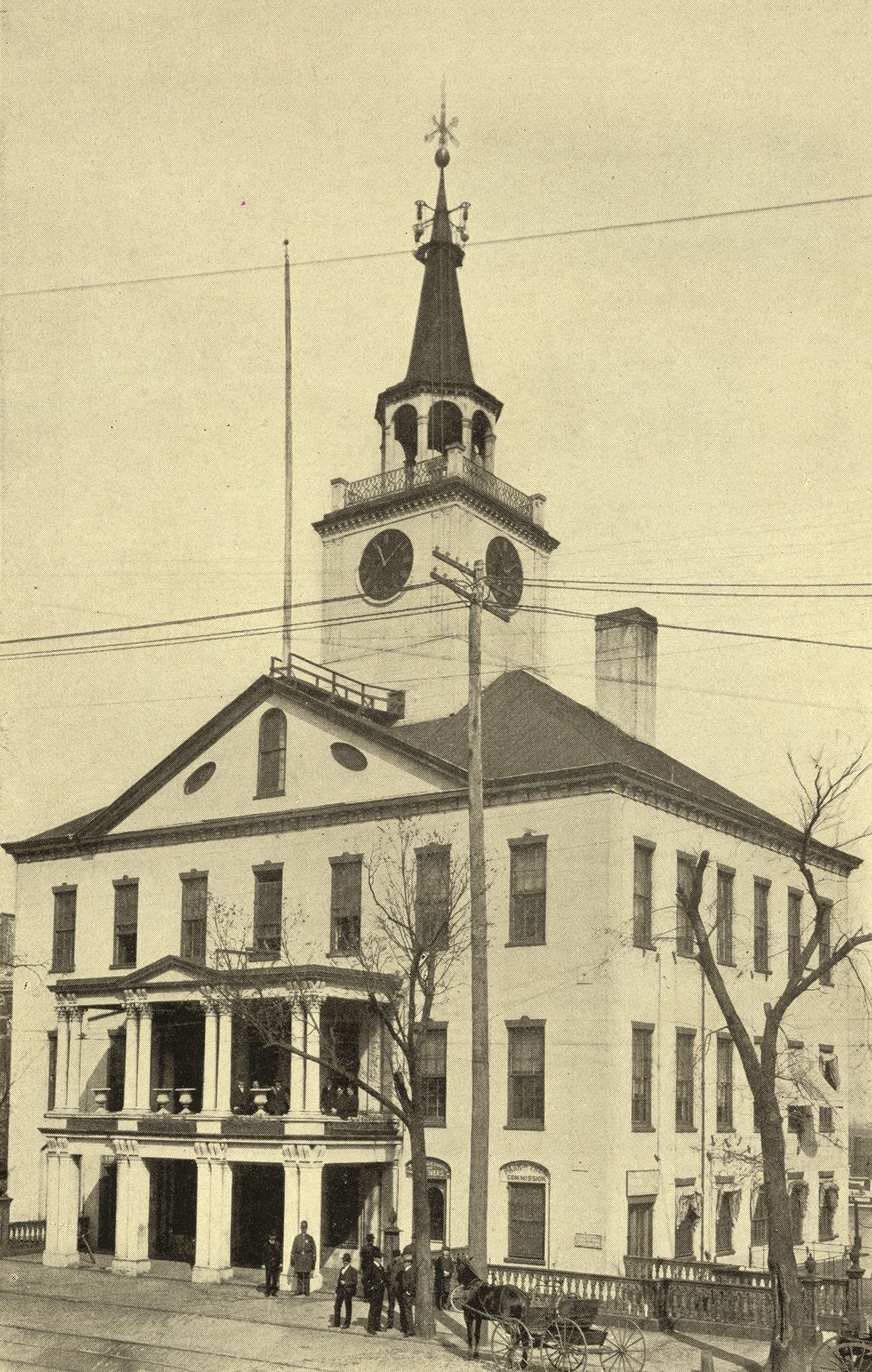
4-20City Exchange, 1904

City of Savannah Municipal Archives

During the same session, Council was presented with a proposition from Thomas H. Gignilliat, of Gignilliat & Smith, architects, to draw plans for a new city hall.  The proposal, read and received as information by Council, indicates that there was already much excitement and talk in Savannah regarding the proposed building.


Report of Special Committee on Site for New City Hall:

The special committee appointed to take into consideration the advisability of erecting a new city hall, beg to report after a thorough investigation of the situation and the most careful consideration of the city’s finances, that in its opinion a new municipal building is urgently needed and steps should at once be taken looking to the erection of a modern and adequate building as soon as possible.  At present the city departments have not the proper room in which to carry on their work, and their operations and usefulness are hampered as a result.  It is impossible by the expenditure of any reasonable sum to make the present City Exchange suitable for the purposes of the city government.  Money expended upon it is largely wasted.  Provisions should be made for a building in which there will be ample quarters for all of the departments, in which the committees of Council will have meeting rooms, in which suitable chambers will be provided for the Mayor, and in which a large room will be had for meetings of Council and for public gatherings.


Your committee after studying the situation closely feels satisfied that the site of the present Exchange is in every way suitable for a new hall.  It is easily accessible from all parts of the city and will remain the center of business interests.  Being the property of the city its use for this purpose will save the city in the neighborhood of $100,000, or almost enough to erect a fine building.  We would accordingly recommend that Council decide upon the erection of a new city hall on the site of the present Exchange; that an appropriation of $500 be made and this committee, or another committee especially appointed for the purpose, be authorized to extend all or part of the same in securing plans, specifications and estimates for a building which will provide ample room for the needs of the municipality for many years to come.


Respectfully submitted,

HERMAN MYERS,

D. R. THOMAS, 

R. J. DAVANT,

Committee.


Upon motion of Alderman Dixon, the report was adopted, an appropriation of $500 was made, and the committee increased to five, Aldermen Dixon and Watson being added -- the committee now standing as follows:  The Mayor, Aldermen Thomas, Davant, Dixon and Watson.


Citizens Support New City Hall , February 20, 1903 

On February 20, 1903, the Savannah Morning News ran an article which summed up the feelings of many in the city regarding City Council’s decision to build a new municipal building on the site of the City Exchange.  The Exchange building, located on Bay Street at the foot of Bull Street, was not only at the center of Factors’ Walk and the commercial district, but literally at the beginning of Savannah’s history, near the site where General James Edward Oglethorpe first pitched his tent in 1733.  Council’s decision to remain on Bay Street “struck a popular chord” with merchants who believed that relocating the seat of City government would amount to a “death blow” to the strip of firms, stores and warehouses.  While “on the other hand, a modern building at the foot of the city’s most prominent promenade would give back to Bay street some of the life and spirit that it has lost.”


Sources: 

“A New City Hall Soon to Be Built.”  Savannah Evening Press (19 February 1903) 5:6.

“For a New City Hall.”  Savannah Morning News (19 February 1903) 10:1.

Official Proceedings of City Council (18 February 1903) 28.  City of Savannah, Clerk of Council’s Office, Savannah, Georgia.

Report of Hon. Herman Myers, Mayor…of the City of Savannah, Ga., Year Ending December 31st 1903….  Savannah, Ga.: The Morning News Print, 1904.  pp 432-433.


To learn more about the planning and construction of Savannah’s City Hall see the City Hall Centennial history documents: